

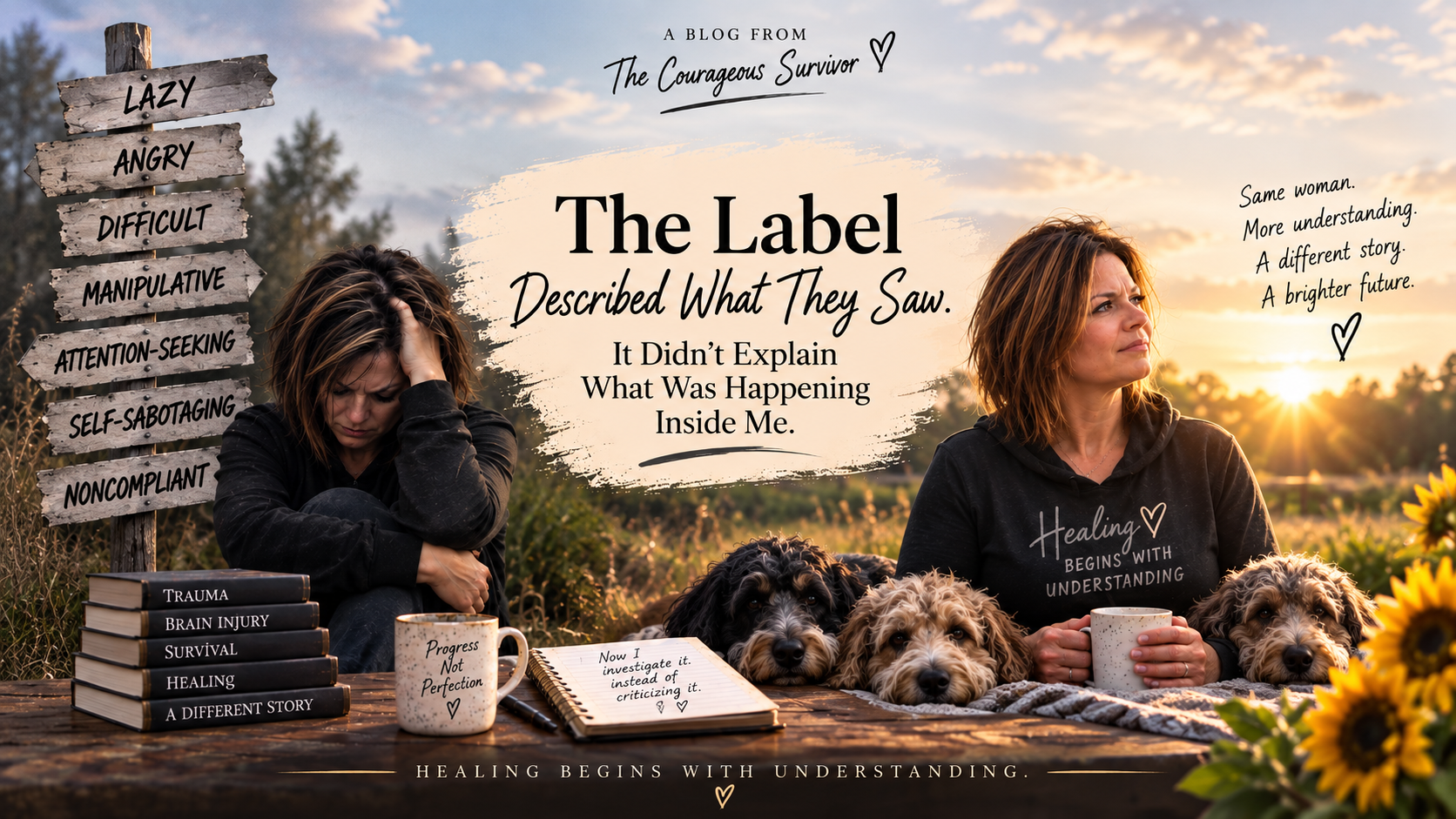
I have been called a lot of things in my life: lazy, unmotivated, angry, difficult, manipulative, attention-seeking, and noncompliant. And if I am willing to look honestly at some of my behavior over the years, I can understand why people used those words.
There were times when I was argumentative. I lied to avoid confrontation. I sought attention in unhealthy ways. I pushed good people away and created chaos when life became too peaceful. I missed appointments, questioned doctors, slept through large portions of my EMS shifts, picked fights, tested relationships, and hurt people who didn’t deserve to be hurt.
Those things happened, and understanding trauma doesn’t require me to rewrite that history or pretend my behavior didn’t have consequences. I don’t need to erase what I did in order to have compassion for why I did it. But here’s what I wish someone had understood much earlier: The label described what they saw. It didn’t explain what was happening inside me.
When “Lazy” Wasn’t Really Lazy
For several years leading up to my first experience with functional neurology, something in me gradually changed. At first it was subtle, but eventually I reached a point where I could sleep through a large portion of an EMS shift and still feel exhausted. It didn’t matter how much sleep I got. I had no energy and very little motivation. I became disengaged from life and operated on autopilot, simply going through the motions.
Doctors saw severe depression. Coworkers and administrators saw someone who was lazy and unmotivated. I didn’t really know what I saw because I didn’t understand what was happening to me. I just knew that the person I had become didn’t feel like the person I remembered being.
Years later, as I began learning about my brain, chronic stress, trauma, and the effects of the brain injury I sustained during a near-fatal strangulation, my behavior started making sense in a completely different way. My brain and body had spent years learning how to survive. Chronic stress and trauma had taken a toll, and then there was the brain injury and the problems happening with the different systems my brain depended on to understand where I was in space and what was happening around me. There was a lot more happening inside of me than anyone could see from the outside.
That doesn’t mean every period of exhaustion is caused by trauma or brain injury, and it doesn’t mean depression shouldn’t be considered. It means my behavior contained information that hadn’t yet been understood. We were looking at what I was doing and trying to name it without understanding everything that was contributing to it.
My body can still move toward some of those old patterns when I overload it today, but the difference is that now I pay attention. I watch patterns in my sleep, resting heart rate, and HRV. I journal about how I’m feeling and notice when my motivation changes or when everything suddenly starts feeling harder than it should. I have learned that those changes are worth paying attention to instead of immediately criticizing myself for them.
Sometimes taking care of myself means changing plans at the last minute. Sometimes it means spending a day in bed with my dogs. Sometimes it means taking an unexpected vacation or sick day and admitting that what I planned to accomplish isn’t what my brain and body need that day. Before, I judged myself for it. Now I investigate it.
When “Angry” Was Actually Protecting Something
There was a lot of hitting in my childhood. Sometimes it was punishment, but sometimes hitting, slapping, or kicking was treated like a joke. If I said something hurt, I might be told I was being a baby. I didn’t understand what those experiences were teaching my nervous system, but I learned to be on guard even when I didn’t consciously know I was doing it.
Even around people I wasn’t afraid of, a quick movement could produce a reaction. I also grew up around a lot of loudness, and speaking loudly became normal. I know I’m still a loud person today. I try to tone it down, but I catch myself getting even louder when I’m passionate or emotionally activated.
Then came June 2006. I survived a violent assault and near-fatal strangulation. I remember freezing. I remember a gun pointed at me, hands around my neck, and believing I was about to die. That night changed me in ways I wouldn’t understand for years.
Looking back, I think the woman who had frequently survived through flight became much more prepared to fight. I became ready to defend myself before someone could hurt me. Sometimes I would start an argument hard and fast because somewhere underneath the behavior was a promise I didn’t even realize I had made: No one is ever getting close enough to do that to me again.
The anger wasn’t imaginary, and my behavior wasn’t always acceptable. Other people could still be hurt by it, and some were. Understanding where my anger came from doesn’t mean everyone on the receiving end of it should have had to tolerate it. But simply calling me angry or aggressive couldn’t tell you why it was happening. And without understanding the why, how was I supposed to learn how to change it?
When I Sabotaged the Safety I Said I Wanted
This may be one of the hardest behaviors for me to look back on because I can see how many people I hurt along the way. For years, I couldn’t tolerate safety, stability, or healthy relationships very well. Sometimes I didn’t simply leave stability; I created the chaos I understood.
I can look back at relationships with safe and healthy people and see times when I searched for something wrong with them. Sometimes I found something, but sometimes I created something in my own mind. There were times when I picked and pushed until the other person finally became frustrated, reacted, or walked away. Then I could tell myself I had been right all along. People leave. People hurt you. See? You’re the victim again.
I even abruptly moved across the country at different points in my life, including North Carolina and New Orleans. There were times when I wasn’t building a new life as much as I was running from the one that was beginning to settle down. Sometimes I was running from chaos, but other times I think I was running because there wasn’t enough chaos. Safety didn’t feel familiar to me. Chaos did.
Today, I work very differently. I slow decisions down and evaluate whether my response is coming from facts or feelings, especially before making a big decision while I’m emotional. I’ve also intentionally created a home where I experience safety, stability, and presence. I am careful about the people I allow into that space, and I recognize certain behaviors in other people much faster now because my system recognizes them.
At the same time, I have to be careful not to assume that every uncomfortable feeling means someone else is unsafe. Sometimes my reaction is giving me important information about the person in front of me. Other times it’s giving me information about myself and something from my past that has been activated. Learning to tell the difference is part of my healing because I had to teach my nervous system something it didn’t know: Familiar and safe are not the same thing.
When “Manipulative” Was a Survival Strategy
This one is uncomfortable to admit too. Looking back, I can understand how manipulative or dishonest I must have appeared at times, and unintentionally, sometimes I was. I was a people-pleaser, but my people-pleasing wasn’t simply about wanting everyone to like me. I had learned an equation very early in life: Mad meant hurt. Love meant obey and please.
How truthful I felt safe being could depend on who someone was and how much power I believed they had to hurt me or affect my life. If confrontation felt dangerous, telling someone what they wanted to hear could feel safer than telling the truth. I learned to read people, adjust myself, and figure out which version of me was safest around which person.
I also tested relationships. There were times when I would push someone toward anger because somewhere inside me I needed to answer a question: Are you going to become like everyone else? If I could get you angry enough and you yelled, threatened, left, or reacted badly, then I had my answer. Unfortunately, sometimes I was helping create the very reaction I was afraid of.
None of that makes dishonesty healthy, and none of it erases the impact those behaviors had on other people. Understanding it does, however, give me somewhere to intervene. Today, I don’t organize my life around keeping everyone happy. I say what I believe, establish boundaries, and am much more willing to let someone be upset with me without immediately feeling responsible for fixing their feelings.
When I catch myself feeling that old urge to appease someone, manage their reaction, or tell them what I think they want to hear, I try to become curious instead of automatically following the response. Why does this person or situation make my nervous system believe I need this old survival strategy again? Sometimes that question tells me something important about the person. Sometimes it tells me something important about me.
When I Needed Attention
Facebook Memories can be humbling. I can look back at old posts and see vague statements that were clearly designed to make someone ask what was wrong. There were periods when I drank too much and behaved in ways intended to get attention from men. I talked about being a paramedic because it gave people something to ask me about, and if someone didn’t text me back, I might text again and again. Then, when I didn’t receive the response I wanted, I could turn around and give them the silent treatment.
I sought reassurance about things I already knew because I needed someone else to tell me I was okay. I would say things about being ugly or not being good enough, hoping someone would tell me otherwise. I would question decisions I had made on EMS calls even when I knew I had done the right thing because I wanted someone else to validate me. I didn’t understand what I was doing at the time, but looking back now, I can see it very clearly.
I had grown up hearing messages about being too fat, too ugly, or not being someone a man would want. Attention became evidence that those messages weren’t true. Even unhealthy attention could temporarily fill that need because, at least for a moment, someone noticing or wanting me seemed to prove something I couldn’t yet believe about myself.
Today, I live very differently. Ironically, I don’t particularly enjoy being the center of attention anymore. Some of my happiest moments are at home with my garden, chickens, dogs, and the outdoors. Maybe that’s part of why homesteading has become so important to me. There is no one there I need to impress, convince, or please. It’s me, my animals, my garden, the outdoors, and a nervous system that is finally learning what peace feels like.
There was a version of me who felt like she always needed to look right, dress right, wear makeup, and somehow prove herself. Today, I’m increasingly comfortable simply being me, and I often show people that real-world version of myself both in person and online. I don’t need everyone to approve of her anymore.
When I Was “Noncompliant”
From 2006 through 2019, I was told more than once that I was noncompliant, but at the time I didn’t really see myself that way. I was receiving diagnoses that didn’t make sense to me. I could function as a paramedic in incredibly difficult environments yet sometimes couldn’t sit quietly and read a book without crying. There were days when I could barely get out of bed because of overwhelming exhaustion. Something wasn’t adding up.
I tried doctors, tests, medications, more doctors, more tests, and more diagnoses. There were mental health diagnoses and autoimmune possibilities. There were medications prescribed for things I wasn’t convinced I had, so I kept searching for an explanation that made sense of the whole picture instead of individual pieces of it.
Eventually, I began missing appointments. Sometimes I was exhausted. Sometimes I forgot. Sometimes I didn’t go because I had stopped believing the appointment was going to help. As my cognitive symptoms worsened, other things started happening too. I forgot bills or paid them twice. I lost my vehicle in large parking lots. I double-booked myself at work and forgot things that I couldn’t understand how I had forgotten.
From the outside, those behaviors could look irresponsible or noncompliant. Inside my life, something was happening that we hadn’t yet identified. That’s why I think words like noncompliant can become so problematic when we allow the label to end the conversation instead of using the behavior to start one.
This one still affects me today. My experiences left me deeply mistrustful of healthcare systems, and I recognize that sometimes I can swing too far in the opposite direction. I research everything, question recommendations, gravitate toward functional and integrative approaches, and am reluctant to take medications without understanding exactly why I’m taking them. I vividly remember a neurologist dismissing functional neurology as “witch medicine,” and experiences like that stayed with me.
I also have to acknowledge something about myself: healthcare can still pull me into my emotional brain very quickly. There are times when I throw the baby out with the bathwater because of how betrayed I felt by systems I trusted to help me. That is something I still have to work on. Understanding my behavior doesn’t mean assuming my reaction is always correct; sometimes understanding means recognizing when an old injury is influencing a present-day decision.
And Then There Is “Difficult”
Maybe this label connects all the others. For much of my life, I mistrusted people because I learned very young that help could come with strings attached. I learned that sometimes someone helping you meant they expected something in return, and I learned that relationships weren’t always safe. Those experiences shaped the way I interacted with people long before I understood what they were doing to me.
I became defensive when I thought I was in trouble because being wrong felt connected to what might happen next. I argued, defended myself, and refused help. Later, I started challenging medical diagnoses and questioning professionals. Some of that came from fear, some of it came from my emotional brain, and some of it came from real experiences that had taught me not to blindly trust people.
Healing hasn’t turned me into someone who blindly trusts everyone, and I don’t think it should. I still watch patterns. I watch behavior. I gather information, question things, and pay attention when something doesn’t make sense. What has changed is that I also question my own reactions.
That’s an important distinction because healing doesn’t mean becoming passive or ignoring your instincts. For me, it means learning to recognize the difference between protecting myself from something that is happening in the present and automatically reacting to something because it reminds my brain and body of the past.
What If the Behavior Is Telling Us Something?
One of the concepts I discuss in my trainings comes from The Myth of Normal by Gabor Maté and Daniel Maté. They discuss how adaptations that begin as ways of maintaining attachment and surviving our environments can become so deeply embedded that eventually they can feel like part of who we are. That concept changed the way I understood myself.
My trauma responses, attachment patterns, and protective behaviors became so familiar that I didn’t experience them as things I was doing. They felt like who I was. Protection, people-pleasing, hypervigilance, chaos, and defensiveness had blended so far into the background that they became normal to me. My nervous system had been wired much more for protection than connection, and I didn’t know there was another way to live.
When those patterns become your normal, imagine how difficult it is when someone walks into your life and tells you that you’re manipulative, difficult, lazy, attention-seeking, noncompliant, angry, or self-sabotaging and then essentially says, Stop doing that. I couldn’t just stop. For a long time, I couldn’t even see what I was doing because these weren’t behaviors I had consciously chosen and practiced. They had become woven into the way I moved through the world.
First, I had to see them. Then I had to understand them. Then I had to take responsibility for them. Only then could I begin the long process of practicing something different.
That is one of the reasons I believe understanding and accountability belong together. Understanding why I hurt someone doesn’t erase their hurt. Trauma doesn’t give me permission to mistreat another person. Brain injury doesn’t mean every behavior should be excused, and being a victim doesn’t mean I wasn’t also capable of hurting people. I was, and I did.
But shame and labels alone didn’t teach me how to change. Understanding gave me information I could actually do something with. Once I could understand what a behavior had been doing for me, I could start asking whether I still needed it and what I wanted to practice instead.
Why I Call Myself The Courageous Survivor
People occasionally question why I call myself The Courageous Survivor. For me, courage isn’t publicly telling people only what happened to me. It’s also being willing to tell you what I did in response to what happened to me.
I have hurt people. I have made unhealthy choices and behaved in ways I wouldn’t choose today. There are relationships I damaged, people I wish I could go back and treat differently, and versions of myself I wish I could sit down beside and explain all of this to. I can’t change those years, but I can own them without returning to shame, and I can use what I’ve learned to teach.
Because somewhere right now there may be a person being called lazy who is completely depleted. There may be an “attention-seeking” person desperately looking for connection, a “noncompliant” patient whose brain is struggling to execute the plan, or a “manipulative” survivor using a strategy that once helped them feel safe. There may be an “angry” person whose nervous system still believes the danger is happening, someone sabotaging stability because chaos feels more familiar than peace, or a “difficult” person whose behavior would make considerably more sense if someone became curious enough to look underneath it.
None of that tells us to ignore harmful behavior. It doesn’t mean there shouldn’t be boundaries or accountability, and it certainly doesn’t mean every unhealthy behavior is automatically a trauma response. It means we should become curious enough to ask another question because behavior is information.
Maybe instead of deciding who someone is based solely on what they’re doing, we need to become curious about what that behavior is communicating. Maybe we stop asking only, “What’s wrong with you?” Maybe we don’t even stop at, “What happened to you?” Maybe we also begin asking, “What is happening inside you because of what happened to you?”
The label may describe what we’re seeing, but understanding what is underneath it may finally give us a path toward changing it.
Healing begins with understanding.
