

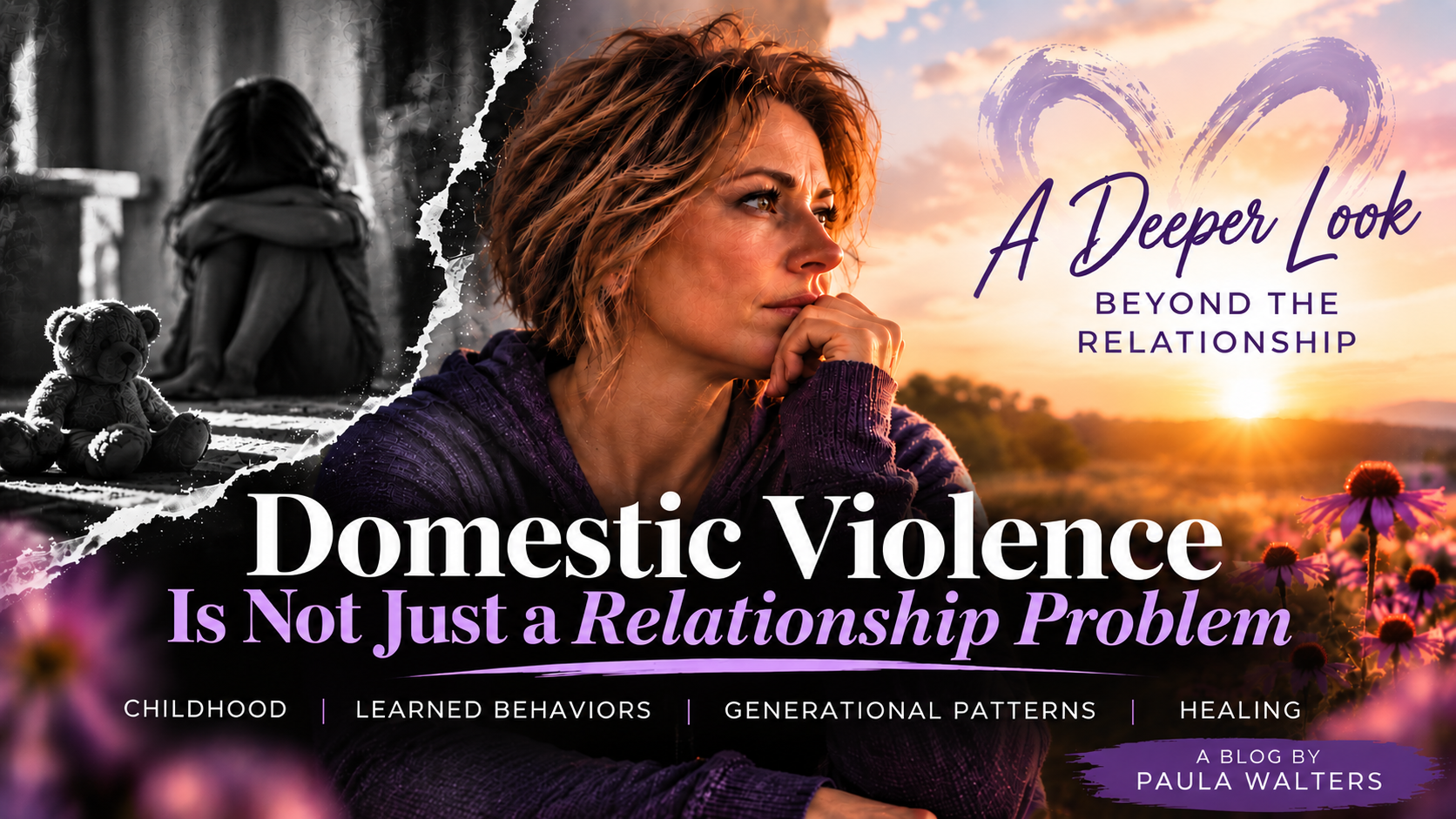
October is Domestic Violence Awareness Month, and every year I watch social media fill with purple ribbons, statistics, survivor stories, and conversations about coercive control, manipulation, anger, violence, and the warning signs of abuse. Those conversations matter. We need them. But the longer I do this work—and the further I get in my own healing—the more convinced I become that we are still having only part of the conversation.
Domestic violence is not just a relationship problem. And it does not always begin when two people enter a relationship. Sometimes, the foundation for what we will eventually accept, tolerate, normalize, or even mistake for love begins being built years before we ever meet the person who will hurt us.
I can see that now because I am not the same woman I was when I entered my abusive relationships. Today, I understand healthy boundaries differently. I understand accountability differently. I understand what belongs to me and what belongs to someone else. I know that someone hitting me is not okay. Controlling me is not love. Jealousy is not proof that someone cares. Walking on eggshells is not simply part of being in a relationship. Being afraid of the person who says they love you is not normal.
That probably sounds obvious to someone who grew up knowing those things.
But what happens when you didn’t?
What happens when chaos was familiar before you were old enough to understand what chaos was? What happens when the relationships around you taught you that love could hurt, adults couldn’t always be trusted, conflict could become explosive, boundaries weren’t respected, and keeping the peace sometimes meant changing yourself? What happens when those experiences become your reference point for what relationships look like?
This is where I think our conversations about domestic violence have to become much deeper.
There was a time in my life when I went from one unhealthy or abusive relationship into another. For years, I could look at those relationships entirely through the lens of what those people had done to me. And to be very clear: they were responsible for their abusive behavior. Nothing about my childhood, trauma, choices, personality, or behavior gave another human being permission to abuse me.
But eventually, healing required me to ask another question.
Why did some of those behaviors not immediately send me running?
That is a very different question than, “Why did I allow someone to abuse me?” I didn’t cause their abuse. But I eventually needed to understand why certain behaviors felt familiar enough that I didn’t recognize them for what they were. Why did I repeatedly find myself in relationships with people who displayed some of the same unhealthy characteristics? What did I believe love was supposed to look like? What had I learned about what I deserved? What did I think I was responsible for fixing? What did I think I was supposed to forgive? Where did I learn those things?
Those were difficult questions because they required me to stop looking only at everyone around me and begin looking inside myself.
And that is one of the parts of survivor healing that I don’t think we talk about enough.
There is a difference between blame and responsibility. I will never accept responsibility for another person’s decision to abuse me. That belongs to them. But I have had to take responsibility for understanding what happened inside of me because of everything that happened to me. I have had to examine my beliefs, patterns, boundaries, expectations, reactions, and definitions of love. I have had to learn what healthy actually looks like instead of simply learning how to identify what is abusive.
That work is exhausting.
Sometimes I understand why people don’t want to do it. Healing isn’t simply reaching the point where you can tell your story without crying. It isn’t posting a survivor quote or declaring that your abuser no longer has power over you. Sometimes healing means discovering that something you believed about yourself, relationships, love, forgiveness, loyalty, or family for decades wasn’t healthy at all.
And then you have to learn something different.
That is what I mean when I talk about rewiring.
We also have to be willing to have this conversation on the other side of domestic violence. People who abuse others did not necessarily wake up one morning and invent their beliefs about relationships either. That never excuses abuse. Understanding is not the same thing as excusing. But if we genuinely want to prevent domestic violence instead of simply responding after someone has already been hurt, we need to be curious about where beliefs surrounding control, entitlement, violence, conflict, power, gender, relationships, and accountability are learned.
Children are watching us.
They are learning what love looks like by watching the adults around them. They are learning how people handle anger. They are learning whether apologies require changed behavior. They are learning whether boundaries matter. They are learning what happens when someone says no. They are learning whether intimidation gets someone what they want. They are learning whether one person’s emotions become everyone else’s responsibility.
Some children will grow up determined never to repeat what they witnessed. Others may repeat pieces of it without even realizing where those behaviors came from. Some may become incredibly skilled at surviving unhealthy relationships because survival was something they practiced long before adulthood.
That is why I believe domestic violence is bigger than a relationship problem.
It is a family issue. It is a childhood issue. It is a generational issue. It is a community issue. It is a brain and nervous-system issue. It is an accountability issue. And ultimately, it is a human issue.
This is also why Domestic Violence Awareness Month can sometimes be difficult for me. For one month, everyone wants to talk about domestic violence. The graphics appear. The statistics get shared. Buildings turn purple. People tell survivors they are strong.
Then October ends.
Domestic violence doesn’t.
If we truly want change, we have to be willing to have difficult conversations in November, March, July, and every other month of the year. And some of those conversations cannot only be about pointing at abusers and saying, “They need to change.” Of course they do. We need accountability. We need consequences. We need safer systems. We need better resources for survivors.
But we also need prevention.
We need healthier families. We need children learning boundaries and emotional regulation. We need people understanding what healthy relationships actually look like before they enter their first one. We need survivors to have access to healing that goes beyond simply getting out. We need to understand how trauma, attachment, brain injury, chronic stress, childhood experiences, and learned behavior can intersect with relationships.
And sometimes we need enough courage to look at ourselves.
I can do that today in a way I couldn’t years ago. I can look at the woman I used to be with compassion instead of judgment. I understand why she made some of the choices she made. I understand why she tolerated things that the woman I am today would recognize immediately. I don’t hate her for it anymore.
I understand her.
But understanding her also means being willing to learn from her.
The woman I am today has boundaries she didn’t have. She recognizes things she couldn’t recognize. She understands that compassion doesn’t require tolerating harmful behavior. She knows that forgiveness and reconciliation are not the same thing. She understands that someone else’s anger does not automatically mean she did something wrong. And she knows that love should never require abandoning yourself to keep someone else.
That transformation didn’t happen because October reminded me that domestic violence exists.
It happened because I spent years asking difficult questions.
Maybe that is where our next chapter of domestic violence awareness needs to go.
Not just: How do we help people leave abusive relationships?
But also: How do we help people recognize healthy relationships? How do we stop unhealthy patterns from traveling from one generation to the next? How do we help survivors understand what happened inside of them because of what happened to them? And how do we raise children who don’t confuse control with love, fear with respect, or chaos with connection?
Those conversations are harder.
But awareness was never supposed to be the finish line.
Healing begins with understanding. And prevention may begin there, too.
— Paula D Walters

Leave a Reply