

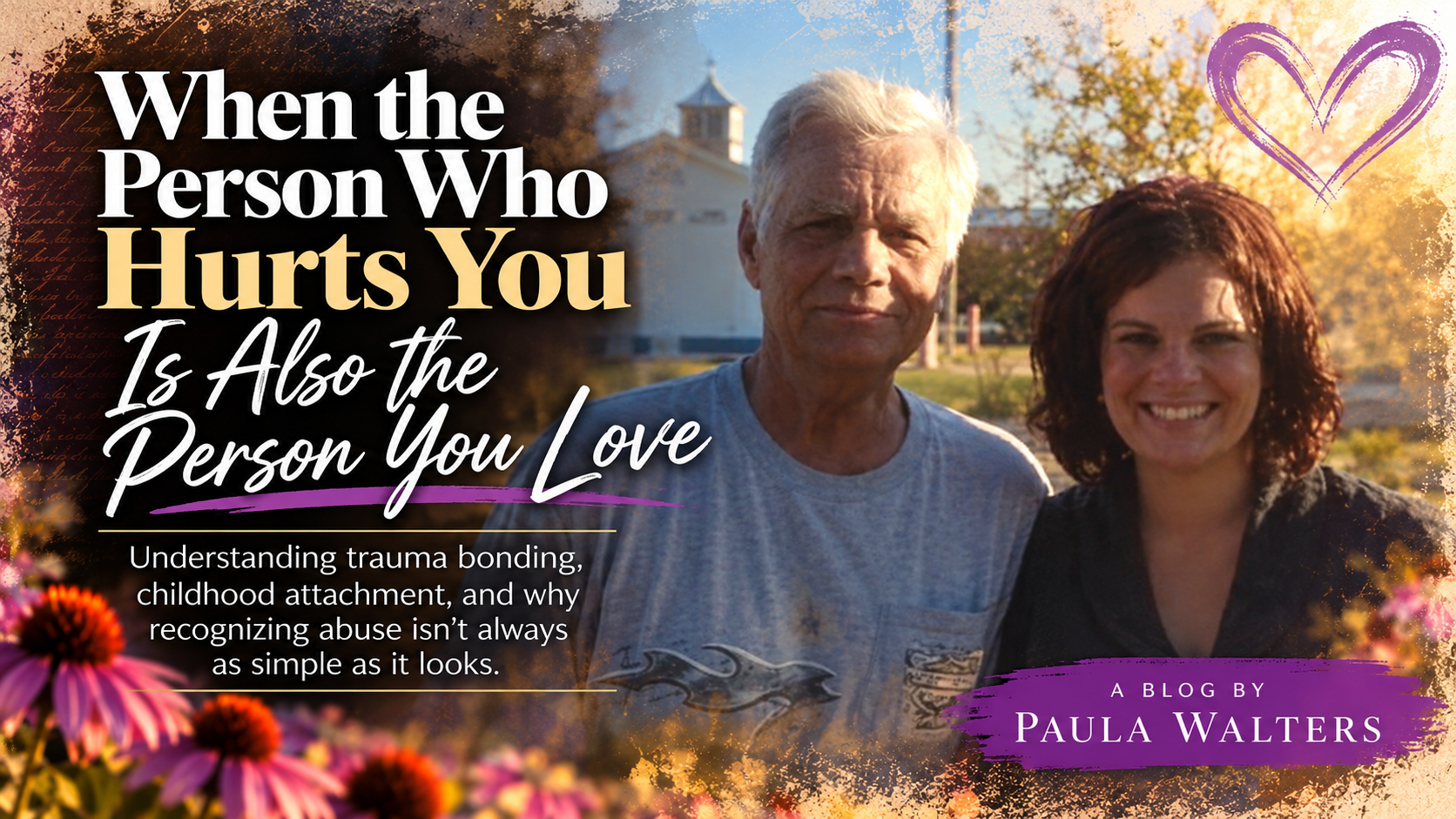
Understanding trauma bonding, childhood attachment, and why recognizing abuse isn’t always as simple as it looks.
There is a question that gets asked about people in abusive relationships more than almost any other: “Why don’t they just leave?”
It seems like such a simple question from the outside. When someone is being hurt, controlled, manipulated, threatened, or emotionally destroyed, leaving seems like the obvious answer. We assume that once someone recognizes the abuse, they should be able to walk away. And if they don’t, we begin looking for explanations in their character, their judgment, their self-esteem, or their willingness to change.
But what if the question itself overlooks something important? What if the person causing the harm is also the person providing comfort, affection, reassurance, and moments of safety? What if the same relationship that creates fear also provides temporary relief from that fear? And what if someone’s earliest experiences taught them that love and pain were supposed to exist together?
This is where understanding trauma bonding becomes so important. Because sometimes the attachment that keeps someone connected to an abusive person is not simply about love, and it certainly isn’t evidence that they enjoy being mistreated. It can involve deeply learned emotional and psychological patterns that developed through repeated experiences of fear, relief, affection, and uncertainty.
And for some of us, those patterns began long before our first romantic relationship.
When Love and Fear Grow Up in the Same House
When I look back at my childhood today, I see things very differently than I did when I was living through them. I grew up in a home where fear, unpredictability, and emotional disconnection were part of everyday life. There were experiences that no child should have to normalize, but when that is the environment you grow up in, you don’t necessarily recognize it as abnormal. It is simply home. It is what you know. It becomes the foundation from which you begin understanding relationships, safety, love, and even your own worth.
My father could be frightening, and my mother was emotionally distant. There wasn’t much physical affection, emotional reassurance, or the kind of connection that teaches a child they are safe, valued, and loved simply because they exist. I learned to pay attention to the moods of the people around me, to recognize when things might become dangerous, and to adjust myself accordingly. Keeping the peace, avoiding conflict, and trying not to become the reason someone was angry were things I learned very early.
As a child, I didn’t have the language to understand what was happening inside me. I didn’t know about attachment patterns, nervous-system adaptations, or the ways chronic stress can shape a developing brain. I only knew what life felt like, and I learned how to function within it.
The difficult part is that children don’t get to choose the environment that teaches them what relationships are supposed to look like. They learn from what they experience. When the people who are supposed to provide protection are also sources of fear, a child may learn to remain emotionally connected while simultaneously trying to protect themselves from harm. The need for attachment doesn’t simply disappear because a caregiver is frightening or unavailable.
For some children, love becomes associated with uncertainty. Affection may feel unpredictable. Approval may depend on behavior. Peace may depend on keeping someone else happy. And over time, these experiences can influence what feels familiar, comfortable, or even desirable in later relationships.
That doesn’t mean everyone who grows up in an abusive home will experience trauma bonding as an adult. It does mean that early experiences can influence how we recognize danger, interpret affection, respond to conflict, and understand what healthy relationships should feel like.
Sometimes what others recognize as a red flag looks completely normal to someone who grew up surrounded by them.
When the Person Hurting You Is Your Parent
One of the things I don’t think we talk about enough when discussing trauma bonding is what happens when the person causing the harm is a parent. We often focus on abusive romantic relationships, but what about the child who grows up loving, needing, and depending on someone who is also frightening or abusive? What happens when the person who is supposed to protect you is someone you also need protection from?
Children are naturally dependent on their caregivers. They don’t have the ability to simply walk away from an unhealthy home, find another place to live, or choose different parents. They need connection, attachment, and a sense of belonging, even when the environment they are growing up in is unsafe. And because children don’t have the life experiences or perspective necessary to understand what a healthy family should look like, they often accept what happens in their home as normal. They adapt to it. They learn how to function within it. They may even defend the very people who are hurting them because those people are still their parents, and the emotional bond remains.
I understand this in a way I couldn’t have explained for most of my life. It wasn’t until around 2015, when a police officer named Todd began asking me questions about my father, that I started to recognize something I had never fully understood about my childhood. I was already an adult. I had experienced domestic violence myself. I had spent years working as a paramedic, responding to emergencies, witnessing abuse, and helping people in difficult and dangerous situations. Yet I had never really looked at my own father through the same lens.
When Todd began asking questions about my dad, he helped me see something that had been right in front of me my entire life. My father had been abusive. The home I grew up in was dysfunctional and abusive. The fear, the unpredictability, the physical violence, the emotional disconnection, and the constant need to monitor someone’s mood were not simply ordinary family experiences. They were things I had learned to live with because I didn’t know anything different.
And what is so remarkable to me now is that I didn’t recognize it.
I knew my childhood had been difficult. I knew my father could be frightening. I knew there were things that happened in our home that I didn’t like. But I hadn’t connected those experiences to the larger picture of abuse, childhood trauma, and the ways my environment had shaped my understanding of relationships. I had lived through it, adapted to it, and carried those adaptations into adulthood without fully understanding what had happened to me.
I think this is something people who grew up in healthy, emotionally safe homes can struggle to understand. How can someone not recognize that their own parent was abusive? How can a child experience frightening or harmful behavior and still love that parent, seek their approval, defend them, or believe that their family was normal?
But children don’t begin life with a definition of healthy love and then compare their parents against it. Their parents and home environment help create that definition. When fear, punishment, emotional distance, and unpredictable behavior are woven into everyday family life, those experiences can become part of what a child understands relationships to be. And when there are moments of normalcy, affection, laughter, family activities, or simply the absence of conflict, those moments can make it even harder to recognize the larger pattern.
A child can love an abusive parent. A child can want that parent’s approval. A child can feel loyal to their family and still be harmed by what happens inside that home. Those feelings are not contradictions. They reflect the complicated reality of childhood attachment, especially when dependence, fear, love, and survival become intertwined.
Not every attachment to an abusive parent is accurately described as a trauma bond. Childhood attachment is complex, and children remain connected to caregivers for many reasons, including their fundamental dependence on them. But some abusive parent-child relationships do involve the repeated harm, intermittent kindness, and emotional dependence associated with trauma bonding. Understanding that distinction matters because we should never mistake a child’s love or loyalty for evidence that the relationship was safe.
Looking back, I can see how much of my childhood I spent learning how to survive the environment around me rather than recognizing that the environment itself was unhealthy. I wasn’t sitting there analyzing whether my father’s behavior was abusive or whether my mother’s emotional distance was affecting me. I was a child trying to get through the day, trying to avoid conflict, trying to find places where I felt safe, and trying to make sense of the world with the limited understanding I had.
It took someone outside that environment asking different questions for me to begin seeing my childhood differently. And even then, understanding didn’t happen all at once. It has taken years of learning, reflection, and healing to recognize how deeply those early experiences influenced my beliefs, behaviors, relationships, and sense of what was normal.
This is why I believe we have to be careful when we ask people why they didn’t recognize abuse sooner. Sometimes the abuse began before they were old enough to understand what abuse was. Sometimes the person hurting them was also the person they were taught to love, respect, obey, and remain loyal to. Sometimes what we see as obvious warning signs were simply the conditions under which someone learned to live.
And sometimes, as it was for me, it takes decades and one person willing to ask the right questions before someone begins to recognize that the home they grew up in wasn’t nearly as normal or healthy as they believed.
That conversation with Officer Todd didn’t change what happened in my childhood. But it began changing how I understood it. And once I started seeing those experiences differently, I could begin understanding the patterns that followed me into adulthood.
Because how can we recognize what healthy love is supposed to look like when the people who first taught us about love were also the people teaching us how to survive fear?
What Is Trauma Bonding?
Trauma bonding describes a powerful emotional attachment that can develop between a person experiencing abuse and the person causing that abuse, particularly when the relationship involves repeated cycles of mistreatment, intermittent affection or kindness, and unequal power.
Imagine being in a relationship where someone repeatedly criticizes, intimidates, threatens, humiliates, or harms you. Those experiences create distress, fear, and uncertainty. But then something changes. The person apologizes. They become affectionate. They promise things will be different. They show tenderness, offer reassurance, or remind you of the person you fell in love with.
For a moment, the fear subsides. There is relief. There is hope. Perhaps there is even a renewed sense of closeness.
And that relief can be incredibly powerful.
When kindness and affection arrive unpredictably between periods of mistreatment, the attachment can become difficult to untangle. In psychology, intermittent reinforcement helps explain why unpredictable rewards can maintain certain patterns of behavior. Within an abusive relationship, moments of affection, reconciliation, or relief may contribute to someone continuing to hope for change, even when the harmful behavior repeatedly returns.
But trauma bonding is more complicated than one psychological mechanism. It can also involve emotional dependence, threats, isolation, financial control, fear of retaliation, shared children, religious beliefs, shame, and genuine feelings of love. The person experiencing abuse may be trying to preserve a relationship while simultaneously trying to survive it.
And sometimes the person who has created the distress becomes the person the survivor looks to for relief.
Think about how confusing that can become. The same individual who causes someone to feel frightened or emotionally devastated may also be the person who holds them afterward, tells them everything will be okay, and promises never to hurt them again. The comfort feels real, even when the larger pattern remains harmful.
Over time, someone may become increasingly focused on getting back to those good moments, hoping that if they can just say the right thing, do the right thing, or avoid the next conflict, the loving version of that person will remain.
From the outside, people may see someone repeatedly returning to an abusive relationship. From the inside, that person may be trying desperately to return to the moments when the relationship felt safe.
What Happens in the Brain and Nervous System?
Our brains are constantly learning from experience. They pay attention to patterns, particularly patterns involving danger, connection, and survival. When someone experiences repeated fear or unpredictability, their stress-response systems can become more reactive, and their attention may become increasingly focused on recognizing potential threats.
In an abusive relationship, this can mean constantly monitoring someone’s facial expressions, tone of voice, body language, or emotional state. A survivor may become highly skilled at recognizing subtle changes that signal an argument, an outburst, or an escalation. What someone else might describe as being overly sensitive may actually be an adaptation developed through repeated exposure to danger.
The brain’s reward and attachment systems are also involved in human relationships. Affection, reassurance, closeness, and relief can all influence how we experience connection. Researchers continue to explore the complex interactions between stress, attachment, learning, and reward in abusive relationships. There is no single chemical or brain region that explains trauma bonding, but these systems help us understand why an attachment may persist even when someone intellectually recognizes that a relationship is harmful.
This is something I wish more people understood: knowing something is unhealthy does not automatically mean that every emotional response, learned pattern, or attachment disappears.
A person may understand that they are being abused and still miss the person causing the abuse. They may know that leaving is necessary and still experience grief, fear, longing, guilt, or uncertainty. They may feel physically safer after leaving but emotionally overwhelmed by the loss of the relationship they hoped they had.
Those feelings do not mean the abuse was acceptable. They do not mean the survivor made the wrong decision by leaving. And they do not mean the person causing harm was incapable of showing genuine affection.
They mean that human attachment is complicated, especially when it develops alongside fear and repeated harm.
Why Leaving Doesn’t Always Break the Bond
One of the biggest misunderstandings about abusive relationships is the belief that once someone physically leaves, the emotional connection should end.
But leaving a relationship and healing from the relationship are two very different processes.
Someone may leave because they recognize the danger, because they fear for their children, because the violence has escalated, or because they finally have the resources and support necessary to get away. Yet they may still think about the good memories, wonder whether the other person has changed, or question whether the abuse was really as bad as they remember.
They may grieve the relationship they wanted, the family they hoped to build, the promises that were made, and the future they believed was possible. They may miss the affection, the familiar routines, or the moments when the person seemed loving and attentive.
And when the person causing harm reaches out with apologies, promises, or reminders of those good moments, the emotional pull can become even stronger.
This is why telling someone to “just move on” or “stop thinking about them” often misses the deeper experience. Recovery may involve learning to recognize the entire pattern rather than focusing only on isolated moments of affection or harm.
It may also involve rebuilding a sense of identity that became intertwined with keeping the other person happy, preventing conflict, or trying to earn love and approval.
For some survivors, the work of healing includes understanding why a relationship that was so painful could also feel so difficult to leave behind.
Trauma Bonding Isn’t Always Romantic
Although trauma bonding is frequently discussed in the context of intimate partner violence, similar attachment dynamics can occur in other abusive relationships involving power, dependence, repeated harm, and intermittent kindness.
A child may remain deeply attached to a parent who is frightening, abusive, or emotionally unavailable. An adult may continue seeking approval from a family member who repeatedly humiliates or manipulates them. People in coercive groups or other exploitative relationships may experience complicated emotional attachments to individuals who control or harm them.
Not every unhealthy relationship, difficult family dynamic, or shared traumatic experience is a trauma bond. The term is most useful when we are examining a specific pattern of abuse and attachment rather than applying it to every relationship that causes emotional pain.
Still, understanding these dynamics can help us recognize why someone may defend a person who hurts them, minimize harmful behavior, or struggle to separate emotionally from someone who has repeatedly violated their trust.
It can also help professionals approach survivors with greater compassion and fewer assumptions.
As someone who has spent years working in emergency medicine and training professionals who encounter victims and survivors, I believe this understanding matters tremendously. When someone returns to an abusive relationship, changes their story, minimizes an incident, or expresses concern for the person who harmed them, those behaviors are often interpreted as evidence that the situation isn’t serious or that the person doesn’t want help.
But behavior does not always tell us what we think it does.
Sometimes behavior reflects fear. Sometimes it reflects attachment. Sometimes it reflects survival strategies that developed over many years. And sometimes it reflects very real concerns about housing, children, finances, retaliation, or what might happen if the survivor leaves.
Our responsibility is not to assume we understand someone’s decisions simply because we can observe their behavior.
Our responsibility is to become curious about what may be happening underneath it.
Healing Means Learning a Different Kind of Love
There is something else about trauma bonding that I think deserves more attention. Healing is not simply about ending an abusive relationship. Sometimes it involves examining the beliefs and patterns we carried into that relationship long before it began.
For me, part of my healing journey has involved looking back at the little girl who learned to navigate fear, emotional distance, and unpredictability. I can now recognize how experiences that once felt ordinary influenced my understanding of relationships and my responses to the people around me.
I have had to learn that love should not require constant vigilance. That disagreement does not have to mean danger. That affection should not have to be earned through obedience, silence, or self-abandonment. And that peace is not simply the absence of someone’s anger.
Those understandings didn’t happen overnight. They developed through years of reflection, learning, healing, and beginning to see my experiences through a different lens.
One of the most complicated parts of healing is that healthy relationships may initially feel unfamiliar to someone who has spent much of their life surrounded by chaos. Consistency can feel strange. Calm can feel uncomfortable. Being treated with kindness without having to earn it may take time to trust.
But unfamiliar does not mean unsafe, just as familiar does not always mean healthy.
Healing can involve slowly learning to recognize the difference.
It can mean building relationships where boundaries are respected, conflict does not involve intimidation, and affection is not used as a reward for compliance. It can mean developing the ability to tolerate peace without waiting for something terrible to happen. It can mean grieving what we didn’t receive in childhood while also recognizing that our earliest experiences do not have to determine the rest of our lives.
And sometimes it means extending compassion to the version of ourselves who didn’t yet understand what we can see so clearly today.
We Need to Change the Questions We Ask
When we ask why someone stays in an abusive relationship, we often focus on what we believe the survivor should be doing differently. We look at their decisions, their emotions, their behavior, and their apparent inability to walk away.
But perhaps we should be asking different questions.
What has this person experienced that might influence how they understand love and safety? What patterns of fear, affection, control, and reconciliation have developed within this relationship? What practical dangers or barriers might make leaving difficult? What support would help them regain safety, independence, and a sense of control over their own life?
And perhaps most importantly, how can we respond in ways that do not recreate the shame, judgment, and powerlessness they may already be experiencing?
Because understanding trauma bonding is not about excusing abuse, removing accountability from the person causing harm, or suggesting that survivors have no ability to make decisions.
It is about recognizing that human behavior is shaped by experiences, relationships, learning, and circumstances that are not always visible to the people watching from the outside.
It is about understanding that someone can love a person and still need protection from them. Someone can miss a person and still recognize that the relationship was dangerous. Someone can leave and still struggle emotionally. And someone can spend years believing that a painful relationship is normal because the earliest relationships in their life taught them that love and fear belonged together.
None of those experiences make the abuse acceptable.
They make understanding the survivor even more important.
A Final Thought
I often think about how different my life might have been if someone had helped me understand these things when I was younger. If someone had explained how childhood experiences can shape our understanding of relationships, how fear can become familiar, and how the need for connection can sometimes keep us attached to people who hurt us.
I think about that conversation with Officer Todd around 2015 and how something as simple as asking questions about my father began opening a door to an understanding I hadn’t reached on my own. It wasn’t that the experiences had been hidden from me. I had lived them. I remembered them. But I had never fully understood what they meant or how they had shaped me.
That is one of the reasons I believe so deeply in the power of asking better questions and helping people understand their own experiences without judgment.
I cannot go back and give that understanding to the little girl I once was. I cannot change the relationships I experienced or the years I spent trying to make sense of things I didn’t yet have the knowledge to understand.
But I can use what I have learned to help someone else begin asking different questions about their own life.
Maybe the person who keeps returning to an abusive relationship isn’t simply refusing to see the truth. Maybe they are trying to untangle years of attachment, fear, hope, and learned survival patterns.
Maybe the person who misses someone who hurt them isn’t confused about whether the abuse happened. Maybe they are grieving a relationship that held both real moments of affection and real experiences of harm.
And maybe healing begins when we stop asking people why they didn’t recognize what was happening and begin helping them understand the experiences that made those patterns so difficult to recognize.
Because sometimes the hardest part of leaving isn’t walking away from the person who hurt you. It’s learning that the love you were hoping to receive should never have required you to survive the harm in the first place.
Healing begins with understanding.
With Courage,
Paula

Leave a Reply