

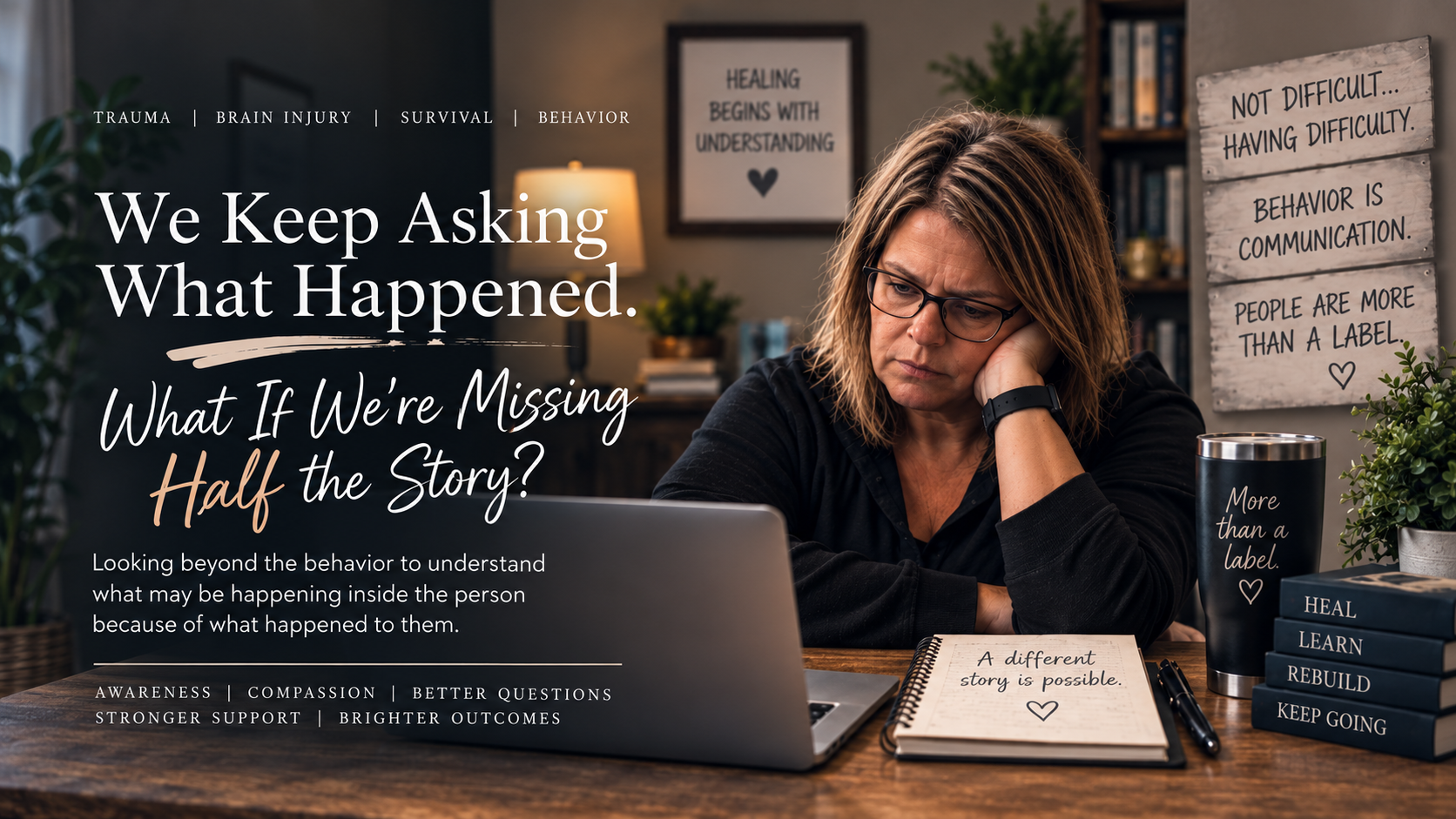
For years, one of the most important shifts in trauma-informed care has been teaching people to move away from asking, “What’s wrong with you?” and toward asking, “What happened to you?”
That shift matters. I believe deeply in it. But the more I understand my own story, the more I wonder whether we have stopped halfway through the question.
We ask what happened to someone. But how often do we ask what happened inside of them because of what happened to them?
That question has become deeply personal for me because I can look backward now with information I did not have then. I can see things happening in my brain, body, and nervous system that neither the people around me nor I understood. I can look at symptoms, struggles, decisions, reactions, and limitations that once seemed disconnected and begin to see how many of them were pieces of a much larger story.
What makes that especially difficult to think about is that some of the people around me during those years worked with survivors.
They weren’t strangers to domestic violence or trauma. Some were professionals who interacted with people experiencing incredibly difficult circumstances. They knew what victimization looked like on paper. They understood many of the words we use when we talk about trauma.
And yet, when it was happening in someone they knew personally, some of them didn’t see what was happening inside of me. They saw what was “wrong” with me.
Some talked about me. Some treated me horribly. Some stopped talking to me altogether. There were people who watched me struggle and interpreted what they were seeing through the information they had at the time. I became difficult, emotional, complicated, or whatever other words may have been used to explain a person who didn’t make sense to them.
The truth is, I didn’t make sense to myself either.
“There Is Always Something”
I remember a boss once saying to me, “There is always something.”
Those words stayed with me because they hurt. I already felt like I was failing at being the person I thought I was supposed to be. I didn’t want there to always be something. I desperately wanted to be okay. I wanted to work, function, think clearly, take care of my family, and live my life without constantly having another problem I couldn’t explain.
Looking back now, there is something almost haunting about that statement because he was right.
There was always something. We just didn’t understand what the “something” was.
There was a brain that had been injured. There was a body that had survived prolonged trauma. There was a nervous system that had learned survival in ways I didn’t yet understand. There were effects from strangulation that had never been adequately explained to me.
There were problems with memory, sensory processing, regulation, cognition, and neurological function that I would spend years trying to understand. There were reasons things kept happening, even when neither I nor the people around me could connect the dots.
When we don’t understand what is happening underneath someone’s behavior, symptoms, or struggles, it becomes incredibly easy to turn those things into judgments about the person. Instead of wondering what might be causing the struggle, we decide the struggle tells us something about who they are.
I know what it feels like to be that person.
What If I Had Needed the Systems More Than I Did?
There is another part of my story I think about more now than I ever did while I was living it. For everything I went through, I actually had relatively limited involvement with many of the systems survivors can find themselves navigating.
I was already a paramedic. I had an education. I understood healthcare. I could speak the language. I knew professionals, and I had spent years responding to emergencies and taking care of other people.
From the outside, I had many of the things we would assume should help someone successfully navigate a crisis.
And I still became incredibly lost.
That makes me think about the survivor who doesn’t have those advantages. It makes me wonder what would have happened to me if I had been forced to repeatedly navigate systems that interpreted my symptoms and reactions as character flaws rather than recognizing that something else might be happening.
What if I had been trying to explain myself to police officers, attorneys, judges, healthcare providers, advocates, caseworkers, or others who didn’t understand what was happening inside of me? What if my memory problems had been interpreted as dishonesty? What if dysregulation had been interpreted as aggression? What if difficulty processing information had been interpreted as refusal or noncompliance?
What if inconsistent behavior had been used as evidence that I couldn’t be trusted?
Those questions are difficult for me because I know how close I came to not surviving what was already happening.
When I imagine adding even more judgment, rejection, misunderstanding, and consequences to what I was carrying, I genuinely don’t know where my story would have ended. I believe I could have become even more lost in systems that were supposed to help me. I could have died by suicide. I could have been murdered. Under different circumstances, I can even imagine a path where my reactions, decisions, or attempts to survive could have resulted in involvement with the criminal justice system.
I don’t say that for dramatic effect. I say it because I know how much of my own story was misunderstood while I was living it.
And I wonder how many people are being misunderstood right now.
We Can Know What Happened and Still Miss Half the Story
We have become much better at talking about trauma. We ask about adverse childhood experiences. We talk about domestic violence. We teach trauma-informed care. We encourage professionals to stop asking, “What’s wrong with you?” and begin asking, “What happened to you?”
Those are important changes, and I never want to minimize how significant that shift has been.
But knowing what happened to someone does not automatically mean we understand what that experience may have changed inside of them.
A person can tell us that she was strangled, and we can still fail to recognize the possibility of brain injury. We can know someone experienced years of coercive control and still become frustrated when she struggles to make decisions. We can know someone experienced trauma and still judge her when her memory isn’t organized into the neat chronological order we expect.
We can know that someone lived in survival mode for years and then expect her brain and body to function as though the danger never happened.
We can even work with survivors every day and still miss it when the person struggling is our coworker, friend, employee, patient, or family member.
I know that because it happened to me.
I don’t share that because I want to remain angry with everyone who didn’t understand me. The truth is that I didn’t understand what was happening either. Many of the people around me were working with the information they had at the time, just as I was.
But that doesn’t mean we shouldn’t learn from what happened.
In fact, I believe we have a responsibility to.
There Is a Person Underneath What We Are Seeing
This is why I keep coming back to behavior. It is easy to see what someone is doing. It is much harder to understand what might be happening underneath it.
We see a missed appointment, an emotional reaction, a confusing story, a poor decision, an inability to follow through, anger, shutdown, or a return to an abusive relationship. We see someone who appears unable or unwilling to do the very thing everyone around them believes they should do.
Then our brains create an explanation. We decide she doesn’t want help. She’s difficult. She’s manipulative. She’s unstable. She’s not trying. She should know better.
There is always something.
But what if there really is something?
What if the “something” isn’t the character flaw we have assigned to the person? What if there is fear underneath what we’re seeing? What if there is cognitive overload? What if there is a brain injury no one has identified? What if their nervous system is responding to perceived danger before they consciously understand what is happening?
What if memory, executive functioning, sensory processing, exhaustion, trauma, or another invisible factor is affecting the person’s ability to do what we are asking them to do?
That doesn’t mean we assume every behavior is caused by trauma or brain injury. It doesn’t mean accountability disappears, and it doesn’t mean dangerous or harmful behavior gets ignored.
It means we become curious enough to recognize that we may not have the whole story.
This Is Why I Keep Talking About It
There are times when I wonder why I keep sharing so much of my life publicly. Some of these stories aren’t easy to tell. It would certainly be easier to put the past away and simply move forward.
But then I think about the version of me who was standing in front of people who could see that something was wrong but didn’t understand what was happening.
I think about the people who judged her and the people who talked about her. I think about the people who treated her differently or walked away because they didn’t understand what they were seeing.
But I also think about the people who eventually became curious enough to look deeper.
Those people helped change my life.
Once I began finding answers, so much of my story changed. Things that had seemed random began connecting. Symptoms, reactions, and limitations that I had interpreted as personal failures started making sense in the context of what my brain and body had survived.
Understanding didn’t erase what happened. It didn’t remove my responsibility for my life, and it certainly didn’t magically make everything easy.
It gave me somewhere to begin.
That is why I am so committed to raising awareness and educating people about trauma, brain injury, strangulation, the nervous system, and what may exist underneath the behaviors we see. This isn’t simply a professional topic to me. I know what can happen when we don’t understand what we’re looking at because I lived it.
Somewhere right now, there is another person being called difficult when they are actually having difficulty. There is a survivor whose confusing presentation is being interpreted as dishonesty. There is a patient being labeled noncompliant. There is someone in a courtroom whose behavior is telling a story that the people around them don’t understand.
There is an employee whose boss thinks, “There is always something.”
And there may be someone sitting at home wondering the same thing I wondered for years: What is wrong with me?
Maybe “What Happened?” Is Only the Beginning
I absolutely believe we need to keep asking people what happened to them. That question helped change the way we understand trauma and shifted us away from immediately defining people by their symptoms and behaviors.
But I don’t think we can stop there.
Because what happened is only part of the story.
We also need to become curious about what happened inside the person because of what happened to them. What did their brain learn? What did their nervous system learn? Was their brain injured? How were memory, attention, sensory processing, decision-making, or emotional regulation affected? What adaptations helped them survive then but may be creating difficulties now?
Those questions could have changed the way people understood me.
I can’t go back and change that part of my story. I can’t make the people who knew me then understand what none of us understood at the time.
But I can use what I know now.
I can keep telling my story. I can keep educating professionals. I can keep speaking to survivors who still believe there is something fundamentally wrong with them. I can keep challenging systems to look beyond what is easiest to see.
And maybe, because we are willing to ask one more question, someone else’s story will turn out differently.
We need to keep asking:
What happened to you?
But then we need to go further:
What happened inside of you because of what happened to you?
Because sometimes what we see on the outside is only half the story.
And the part we cannot see may be the part we most need to understand.
Healing begins with understanding.

Leave a Reply